Section one
Four Into a Space Meant for Two
The main recipe is comfortable with two shoulders. Four is a different animal, and every compromise made to fit them in turned out to matter — though rarely in the way I expected.
-
Stood on end, on the grate. The only way four whole butts fit is vertically. That decision is the hinge on which this entire cook turns, and I did not understand that until the following morning.
-
The lid would not seal. One shoulder was simply too tall to stand under a properly seated lid. Foil went round the rim as a shim, and the barrel spent the night deliberately leaky.
-
Airflow improvised to match. With the lid leaking at the top, some of the rebar holes were partially blocked with foil to compensate. Entirely guesswork, and the thing I was most nervous about going to bed.
-
One meat probe, four shoulders. Whatever the probe said all night, it said about one spot in one butt. I knew that in principle. I had not appreciated how thoroughly it would stop being true.
-
A late start, on purpose. Meat did not go on until after 10 p.m. for a dinner the next evening. It looked like over-caution at the time. It was the single decision that saved the cook.
Section two
Overnight, and the Morning After
Timestamps come straight from the photographs. The night was uneventful in the best sense. The morning was not.
-
1
Loaded, and the lid won’t sit
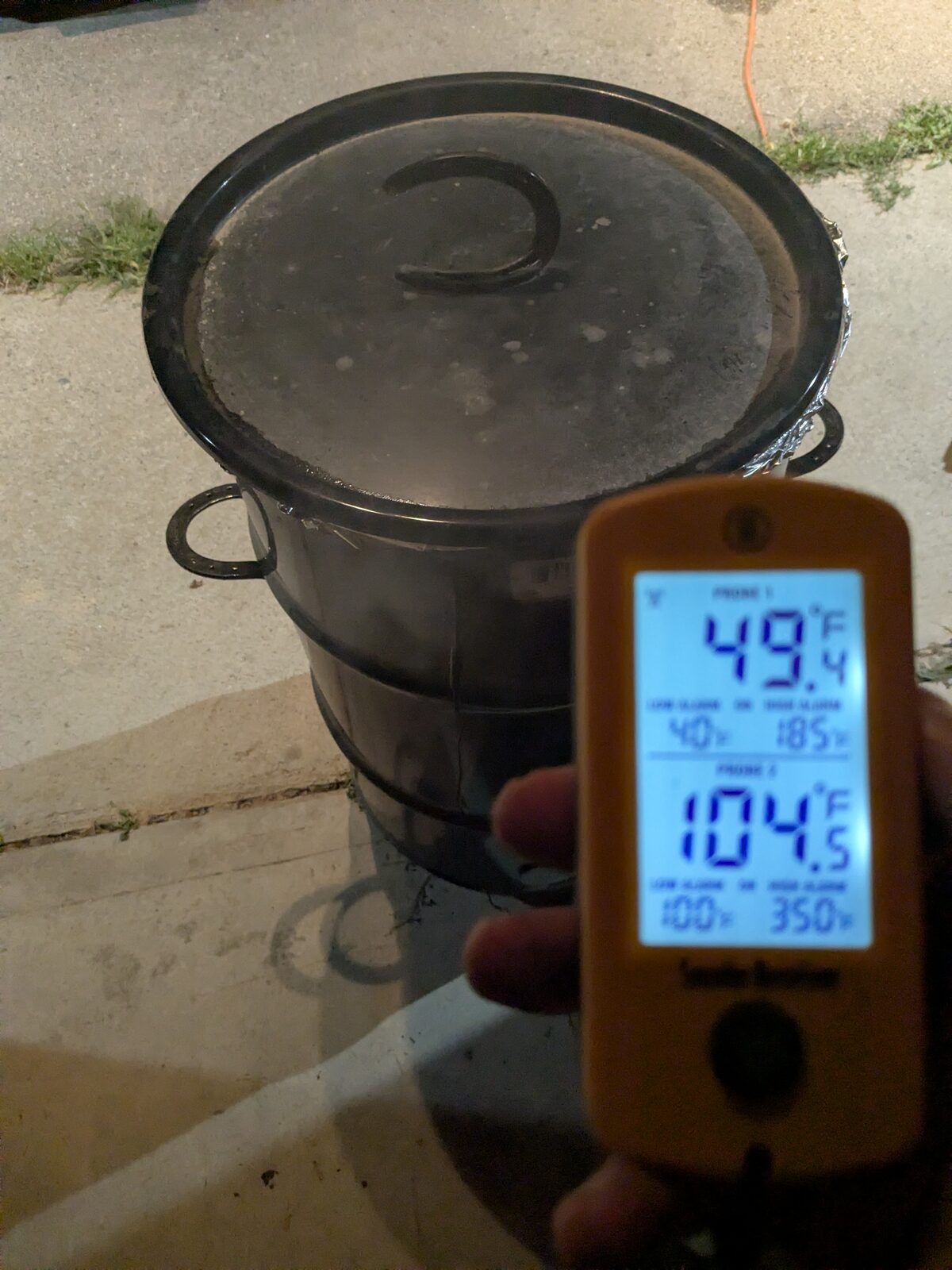
Meat 49.4°F, pit 104.5°F and climbing. Look at the rim: that is aluminium foil packed around the lid where it can’t close, because one shoulder stands taller than the barrel wants. I went to bed with a smoker that was, by design, no longer airtight.
-
2
Alarms set, lights out
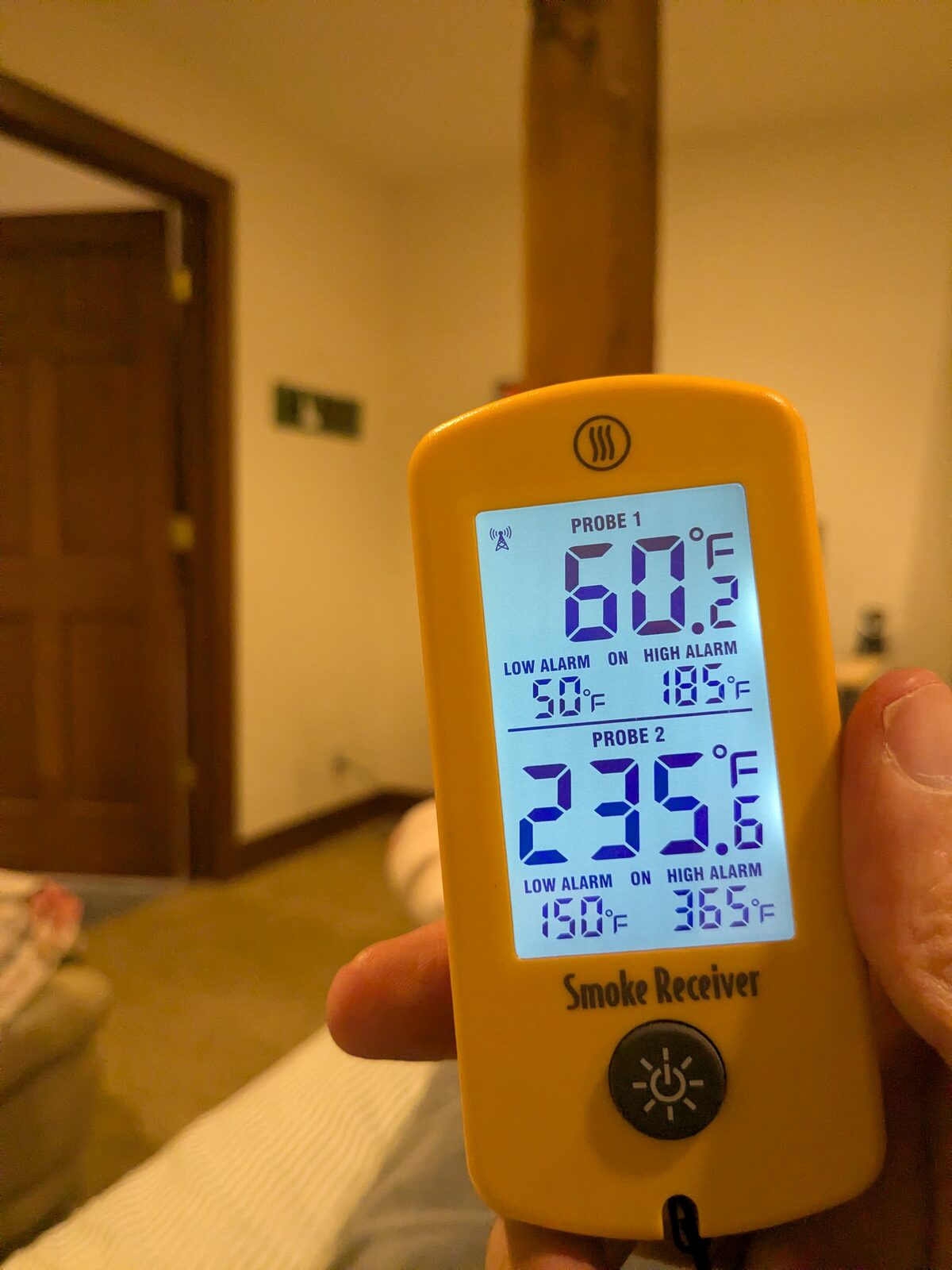
Meat 60.2°F, pit 235.6°F — the leaky barrel settling into a perfectly civilised cruise. The alarms are the whole strategy for an unattended night: meat 50–185°F, pit 150–365°F. Wide enough not to wake the house for nothing, tight enough to catch a fire going out or running away. Neither alarm sounded all night.
-
3
Dawn: the charcoal is finally giving up
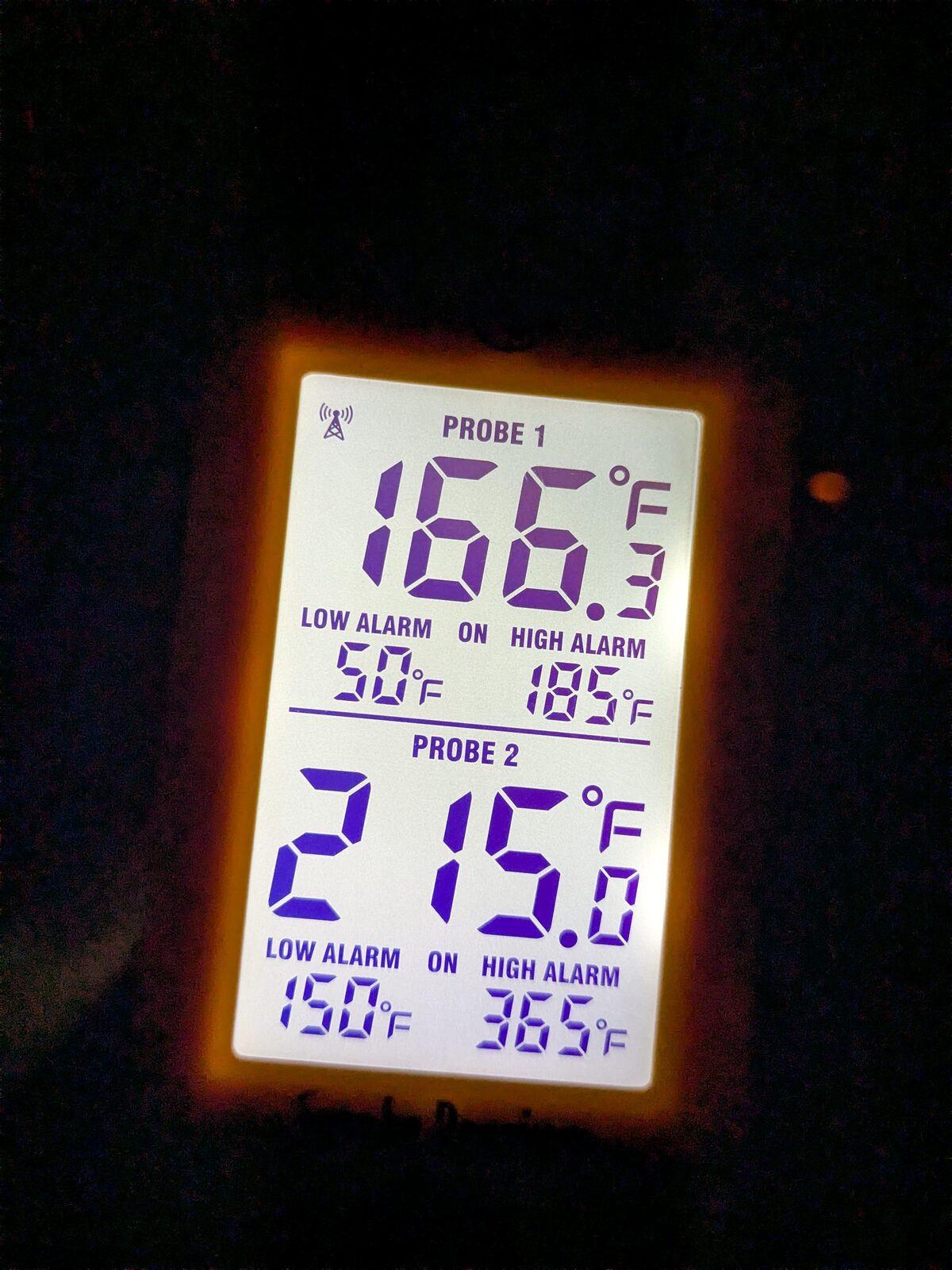
Meat 166.3°F, pit 215°F and falling. Eight hours of unattended fire with a leaking lid, and the basket is only now exhausting itself. That is roughly the endpoint the main recipe hands to the oven anyway — so the barrel had, by any reasonable measure, done its whole job.
-
4
The lid comes off, and it looks wonderful
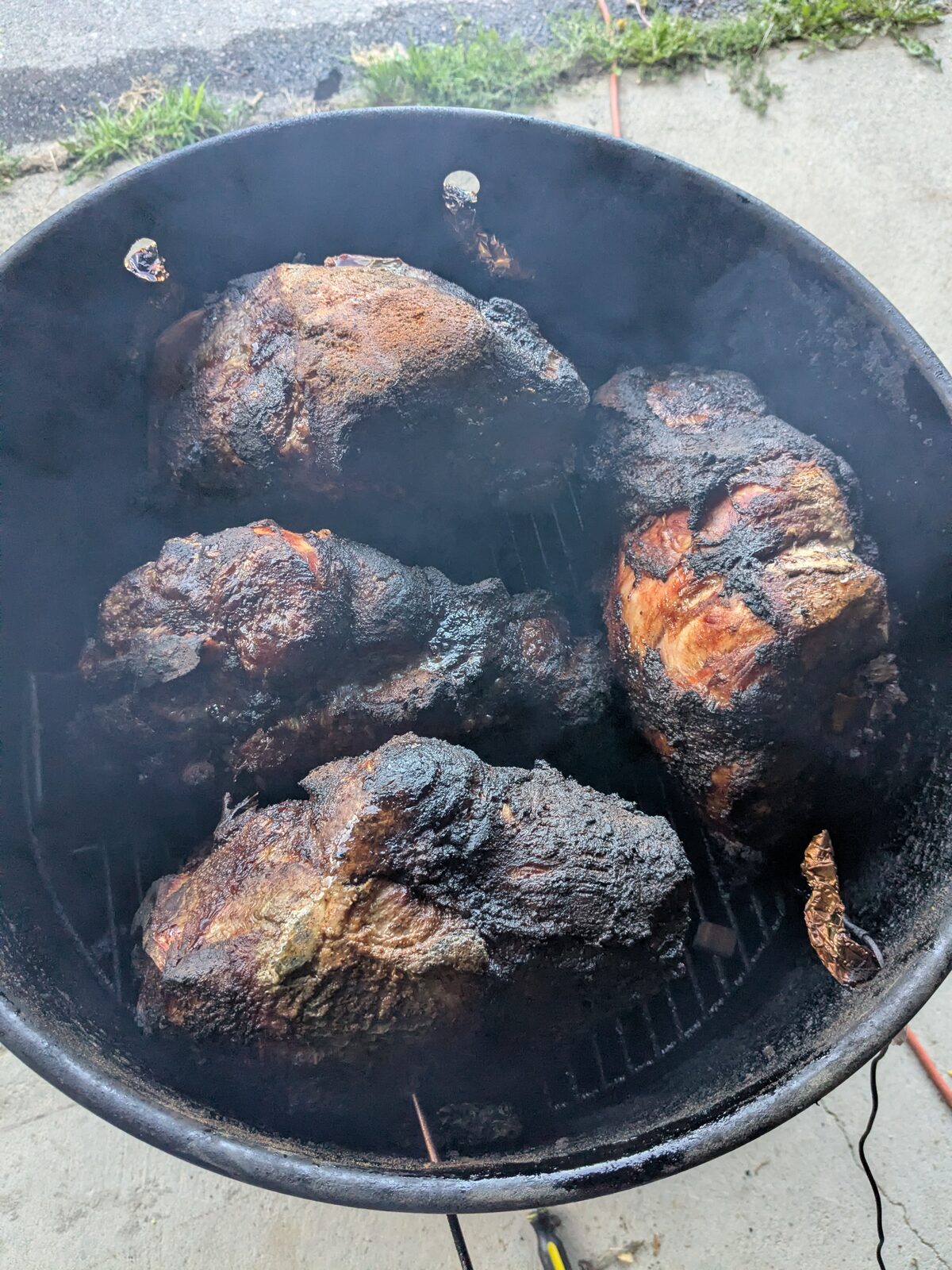
Four shoulders, smoke still drifting, and bark that is frankly better than the main recipe produces — eight uncovered hours will do that. The oversized shoulder is its own control: where it had room, it is as dark as the others; where it was crowded, it is visibly paler. Spacing and orientation mattered more than any temperature target.
At this moment I was pleased. That lasted about ten minutes.
-
5
The overnight history, in four numbers
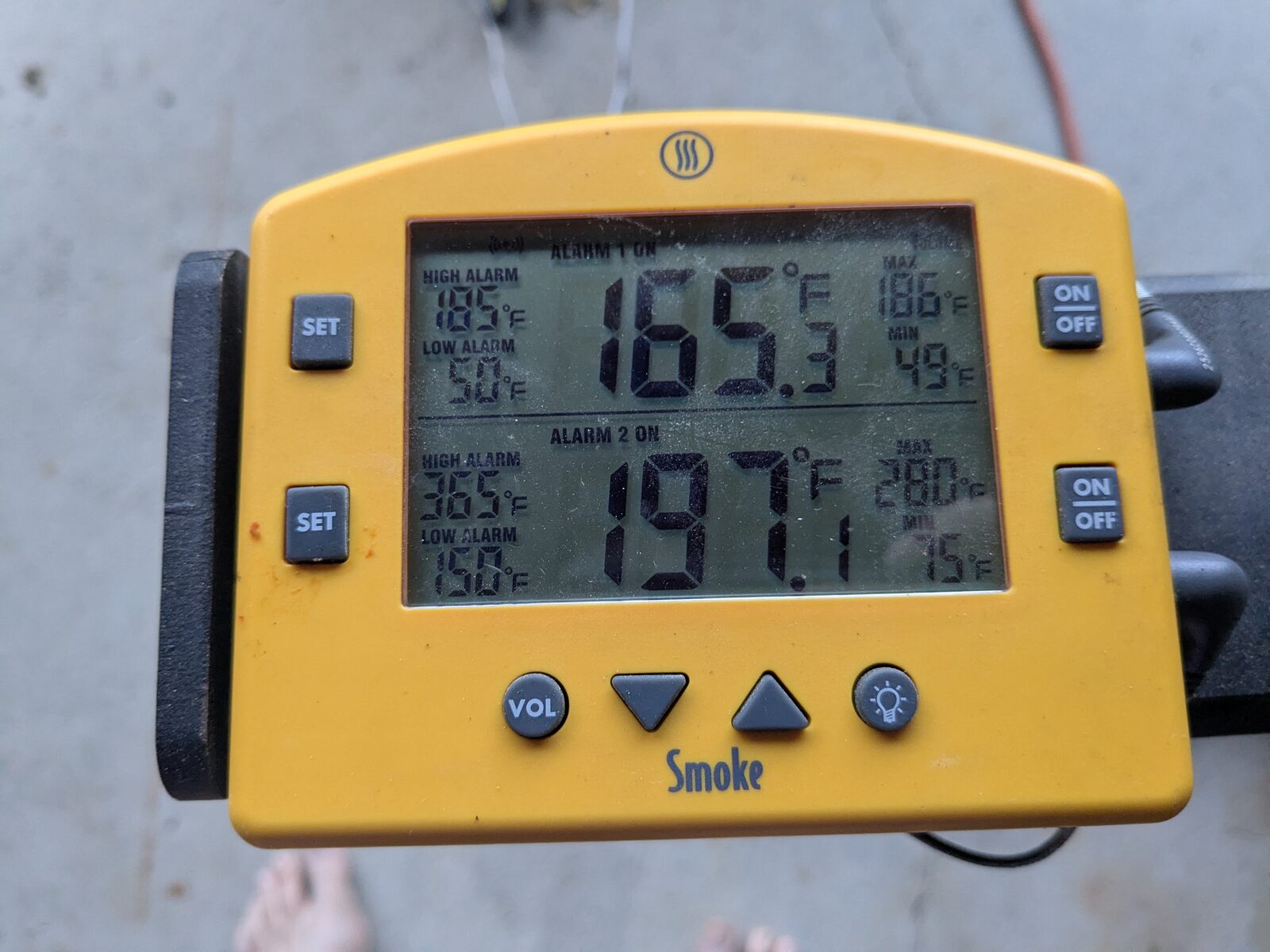
The base unit’s min/max is the most informative photograph of the cook. Meat: 165.3°F now, 186°F max, 49°F min. Pit: 197.1°F now, 280°F max, 75°F min. A leaky lid and foil-blocked rebar holes, and the barrel still never exceeded 280°F all night. The improvised airflow was far more conservative than I feared.
The 186°F meat maximum against 165°F now is almost certainly not a shoulder that cooled twenty degrees — far more likely the probe caught hot ambient air at some point. Treat 165–166°F as the real endpoint of the smoke phase.
-
6
Lifting them out: two pounds stay behind
This is where the cook came apart. The bottoms of the vertical shoulders — the ends sitting directly on hot steel, closest to the basket — were already probe tender, and in places already rendering into the grate. Meat tore. Something like two pounds of pork stayed on the grill when the shoulders came off.
Meanwhile, large parts of the upper halves were nowhere near done. One shoulder was tender throughout. Another was still tight almost everywhere. A pit probe reporting a civilised 200–280°F at grate level had been concealing a brutal gradient running up the length of each standing butt.
-
7
Triage: wrap wet, cook slow, separate the finished one
Every shoulder got a heavier pour of apple cider vinegar than usual and a tight wrap — the goal now being a humid environment that stops the already-done portions drying out while the lagging muscle catches up. The one fully tender shoulder was wrapped in foil and paper and taken out of the active cook entirely, to be held warm.
The rest went into a 225°F oven, not the usual 275°F. With nine hours of schedule in hand there was no reason to push heat at meat that was already partly overdone; what the tough regions needed was time, not intensity.
-
8
Three done, one stubborn
By midday three of the four probed tender and came out. The fourth sat in the 170s and refused to move — almost certainly a shoulder whose upper mass had lagged badly all night. The gentle approach had done what it could, so the oven went up to 275°F for that one alone.
Finish criterion, for all four: probe tenderness in several places, checked from the low 190s onward. Not a number. After what the grate had just demonstrated about gradients, no single temperature was going to be trusted to describe a whole shoulder again.
-
9
All four into a 150°F hold, then one big mix
Once the last shoulder gave in, the oven dropped to 150°F and all four went back in, wrapped, for a hold of several hours. That long warm equilibration is not a consolation prize — it is the step that let temperature and moisture even out across meat that had been cooked wildly unevenly.
At service, all four wrappers were opened over pans and every drop of juice saved. Then all four shoulders were pulled into one batch and thoroughly intermingled — the soft, fatty, over-rendered bottom meat mixed through the drier lagging muscle, defatted juices added back. Judged shoulder by shoulder this cook was a mess. Judged as one pan of pulled pork, it was excellent.
Section three
What It Taught Me
Almost everything I was nervous about turned out fine, and the thing I never considered is what nearly ruined it. That is usually how this goes.
Don’t stand shoulders up on the grate
This is the headline. A vertical butt has one end close to the coals and resting on hot steel, and the other end a foot higher in much gentler air. That is not a few degrees of variation — it is different stages of collagen conversion within a single piece of meat. A shoulder lying flat averages the barrel’s heat across its shape; standing it up turns the barrel’s gradient into the meat’s gradient. If four have to go in again, they hang, or they lie down, or they go in two batches.
A grate-level pit probe can lie by omission
197°F current, 280°F maximum — a perfectly respectable night, and completely silent about the radiant and conductive load on meat sitting inches above the basket. Ambient temperature is not the same as the heat a particular piece of meat is receiving, and in a crowded barrel the gap between those two things is enormous.
Probe tenderness, in several places, or nothing
One probe in one butt described one square inch of this cook. The recovery only worked because doneness got redefined as “slides in easily in several spots, especially near the blade” rather than a number on a screen. If it’s tender at 193°F, stop. If it fights at 203°F, keep going. This rule came out of this cook and has applied to every one since.
The late start was the real hero
Meat on after 10 p.m. for a 5:30 p.m. dinner felt absurdly conservative. But the fourth shoulder was still not done at noon. A conventional early-morning start would have turned that single awkward butt into a genuine crisis; instead it was a mild inconvenience with five hours of slack behind it. Schedule margin is not timidity. It is the thing that converts disasters into anecdotes.
The leaky barrel was fine — genuinely fine
A lid shimmed open with foil and rebar holes partly blocked, and the thing still ran below 280°F all night and never dropped under the pit alarm. The PBC’s stable operating envelope is much wider than its reputation suggests. Next time I would not give this configuration more air; I’d buy four smaller, more uniform shoulders that let the lid seat properly and let the charcoal last longer.
Pulled pork is a blend, and blending is a repair
Nothing about this cook was uniform, and it did not need to be. Four shoulders carry an enormous amount of fat, gelatin and wrapper juice, and mixing everything into one batch — including the couple of pounds recovered from the grate, which was some of the best bark of the night — redistributes all of it. The finished pan is the result. No individual shoulder is.
What carried forward
Two things from this cook are now permanent: probe tenderness over target temperature, and a genuinely generous pour of apple cider vinegar in the wrap. Both are in the working ideal. The vertical grate arrangement is not, and never will be.