Section one
What Was Changed, and Why
There are people in this house who want more bark. The cleanest way to find out how much bark is actually available is to stop compromising and take one all the way naked — then let the household decide whether they like it.
Unchanged
Overnight dry brine, no binder. Single bone-in shoulder on the grate. Standard Kingsford, rebar in the normal holes, ash cleaned out first. Two probes, lid on, no peeking.
Changed
No wrap at 165°F. No oven. The shoulder stays on the fire, uncovered, until it’s done — the intention being at least 180°F, and further if the schedule allowed.
The one worry going in
Giving up the oven means giving up the schedule control that makes the main recipe trustworthy. Tacos were the target; an hour of rest was the minimum. The plan was therefore to let bark-building have priority in the morning and let the clock take over in the afternoon — and to keep the option of wrapping and moving indoors open the entire time, as the escape hatch it is.
Section two
How It Went
Timestamps come straight from the photographs. The escape hatch never got used.
-
1
A genuinely cold start
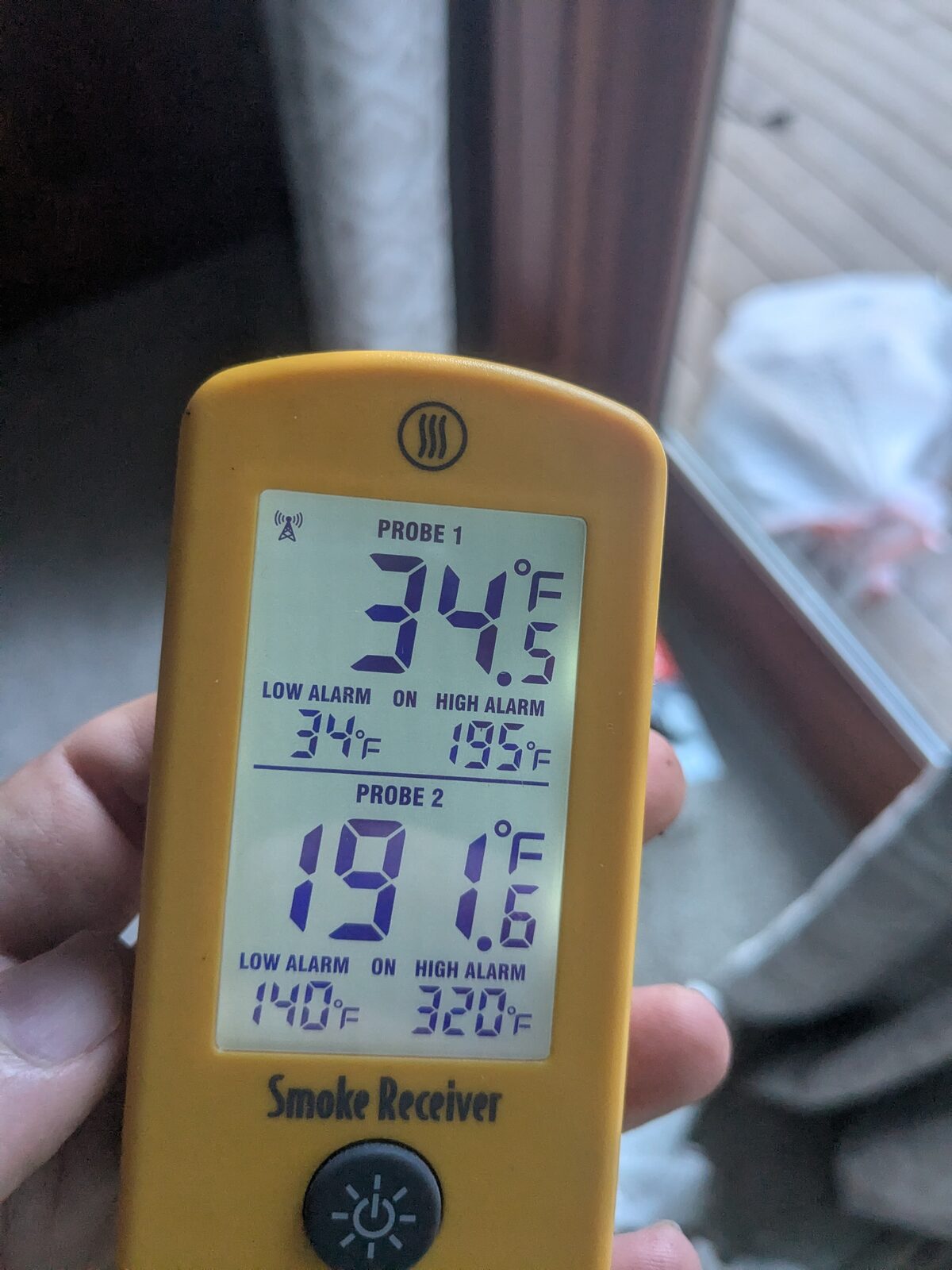
Meat at 34.5°F — colder than I usually load, straight out of a cold refrigerator — and the pit at 191.6°F, still climbing after taking the hit. That reading always looks alarming and never is. Note the high alarm already set to 195°F: on this cook the shoulder is meant to keep going past every temperature I’d normally stop at.
-
2
Two hours in, and running warm
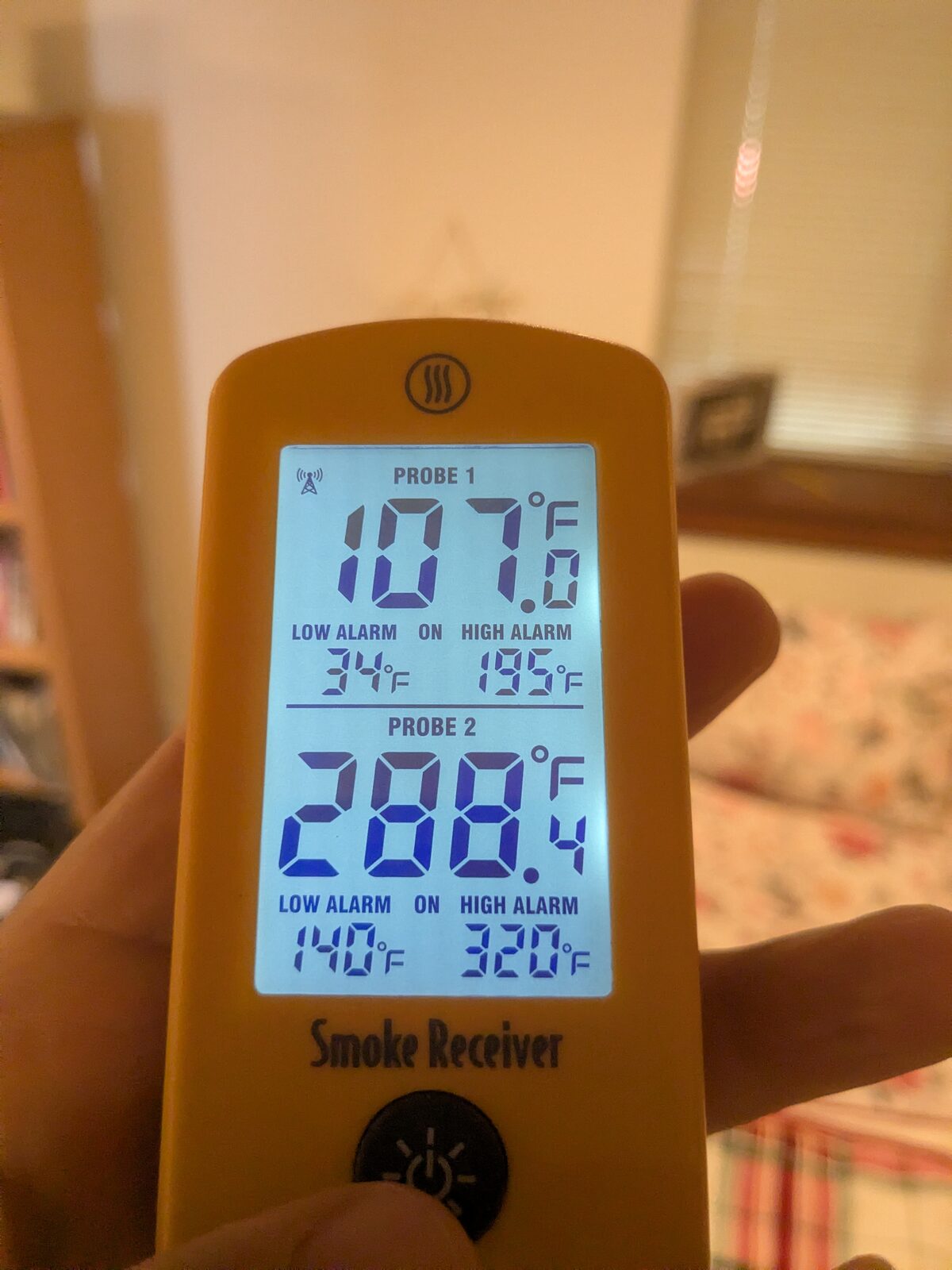
Meat 107°F, pit 288°F. The barrel found the high 280s within an hour of loading and simply stayed there. With a warm day coming I blocked one of the four top vent holes as a pre-emptive brake — not because anything was wrong, but because the only lever worth pulling is the one you pull early.
-
3
Through 175°F without a real stall
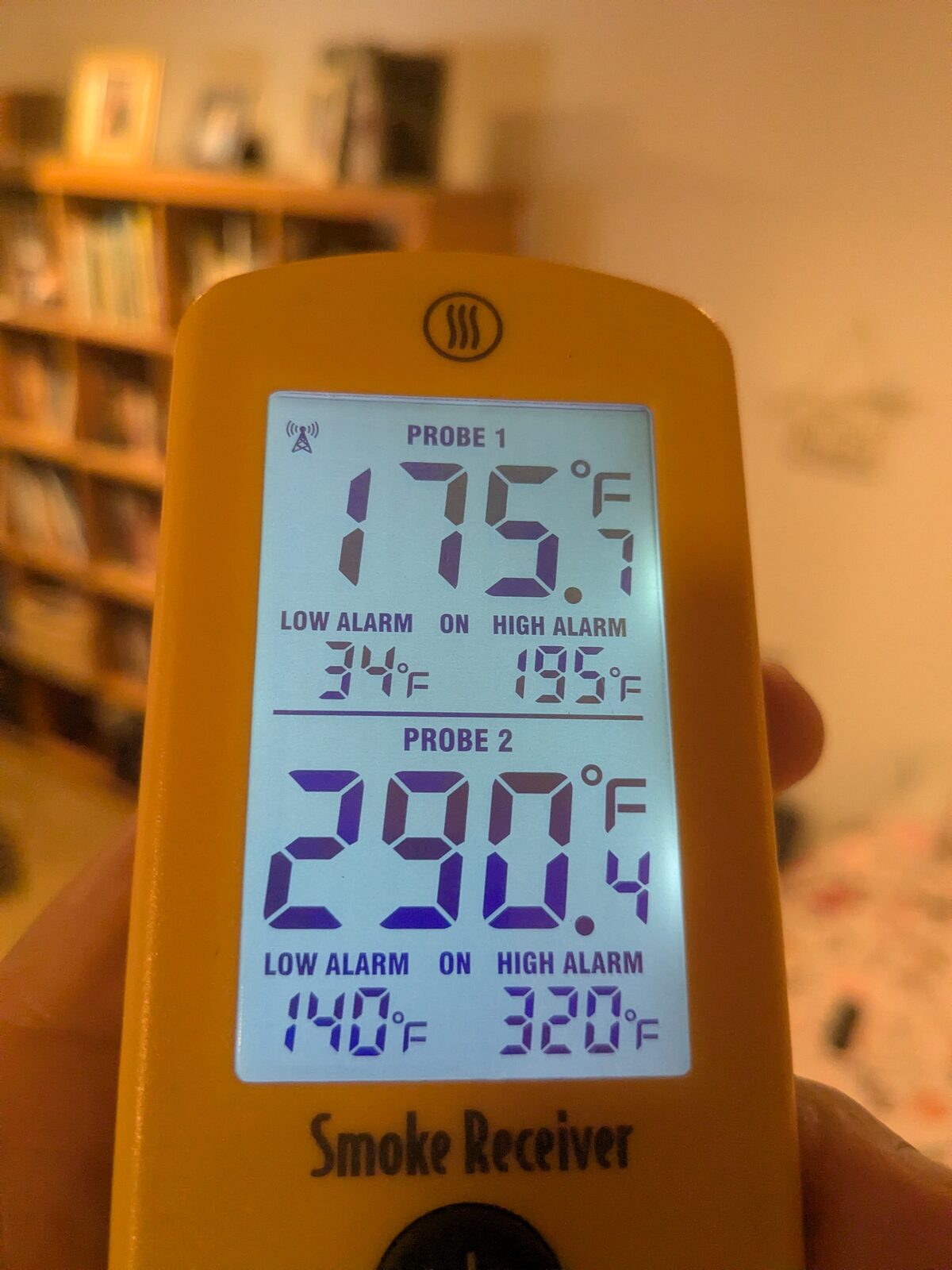
Meat 175.7°F, pit 290.4°F. There was a slowdown in the 150s and 160s but nothing that deserved the name “stall.” This is the finding I did not expect: an unwrapped shoulder at a sustained 290°F does not park for three hours the way the folklore promises. It slows, shrugs, and keeps going.
-
4
A self-inflicted dip, and the fix
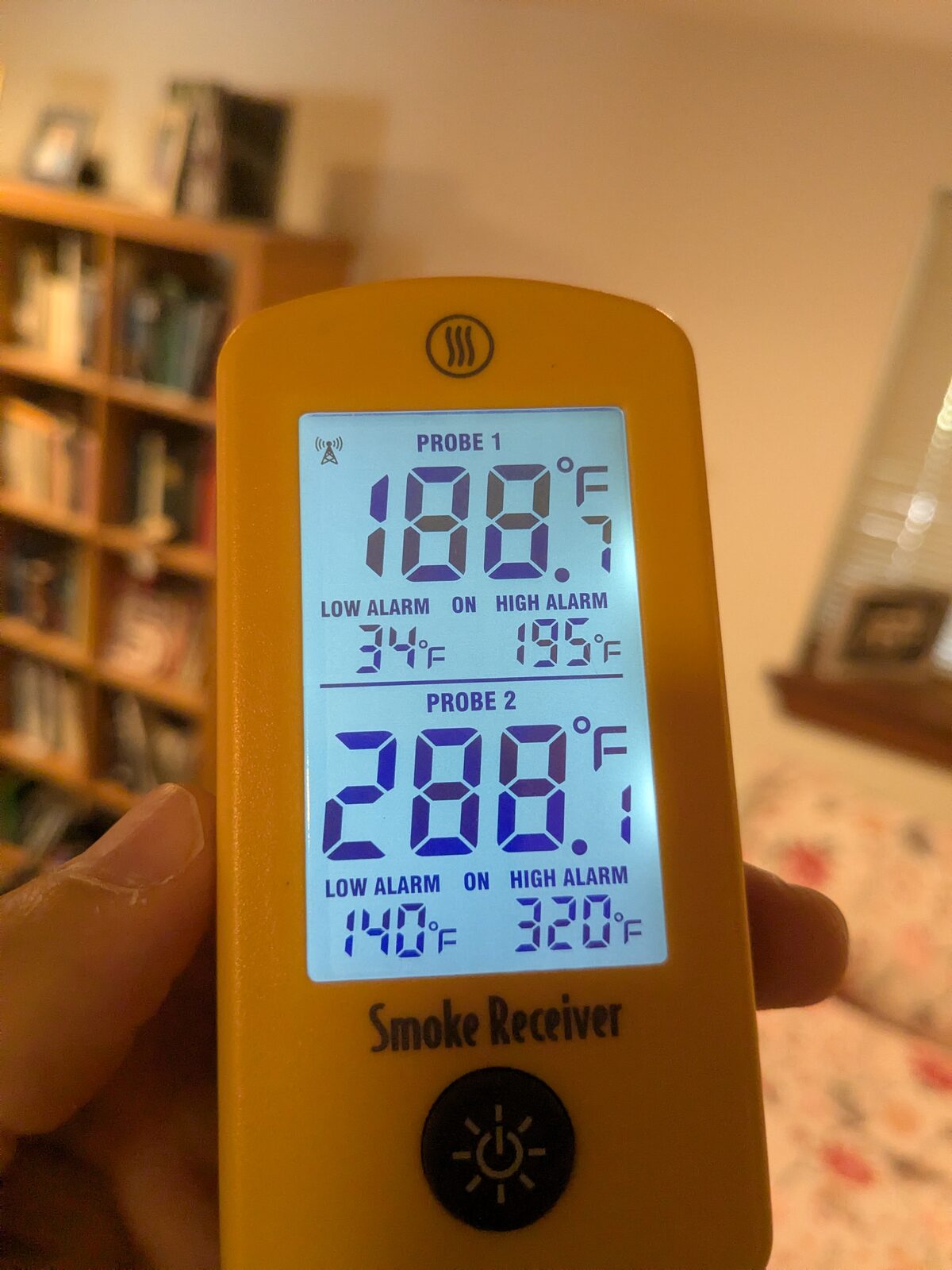
Meat 188.7°F, pit 288.1°F. Shortly before this the pit had sagged into the mid-270s — the bottom intake flap had drifted closed, and my blocked vent hole was now working against me rather than for me. Reopening the intake and pulling the restriction brought it straight back into the 280s. The lesson is a small one and entirely mine: I created that problem two vents at a time.
-
5
200°F, seven hours in
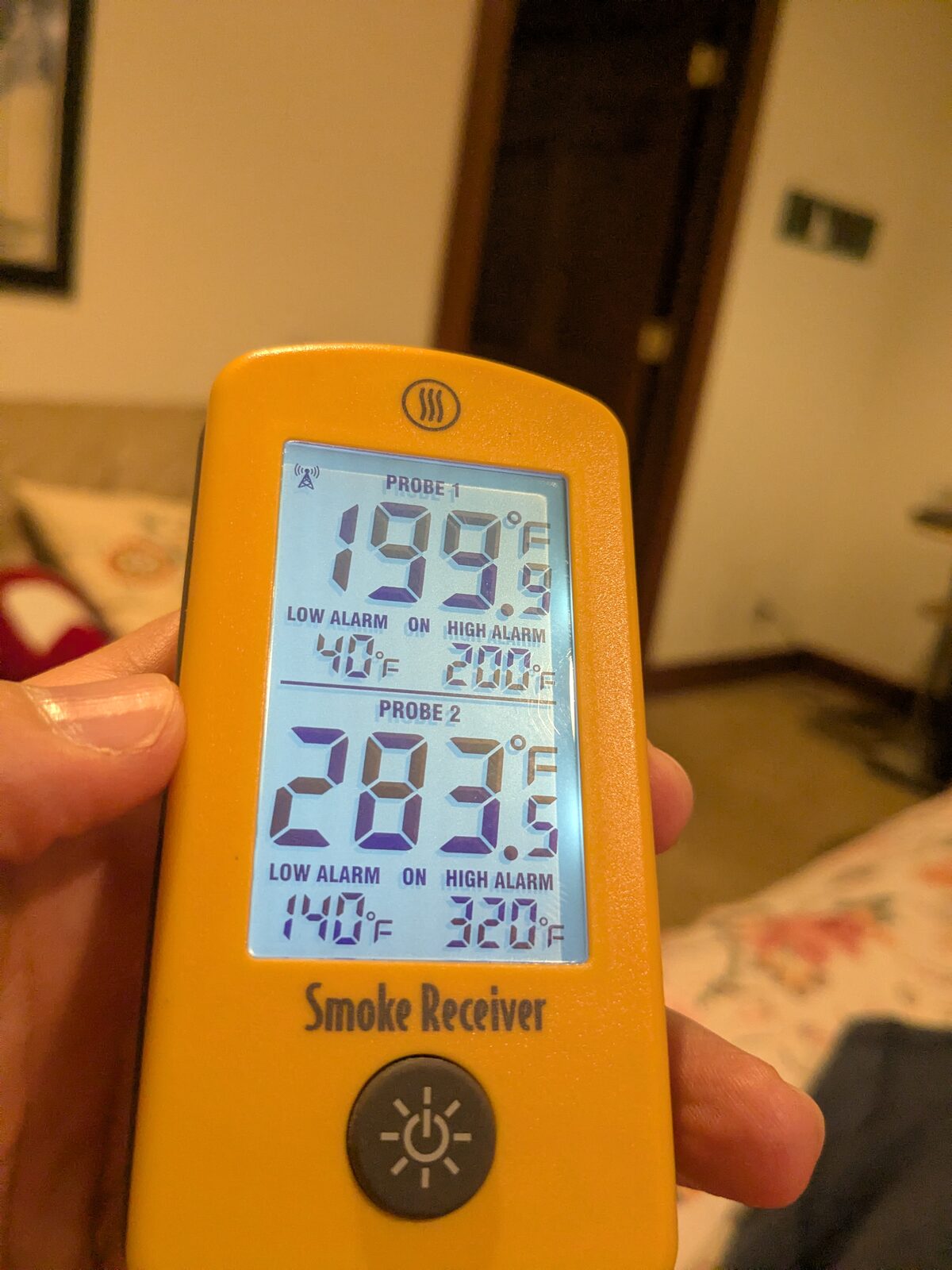
199.9°F, alarm reset to 200°F, pit at 283.5°F. Probing found most of the shoulder genuinely loose, with a few tighter sections hugging the bone — the classic argument for stopping here and letting a long hold finish the job rather than driving the whole thing hotter on a 285°F fire.
-
6
The lid comes off: that is a crust
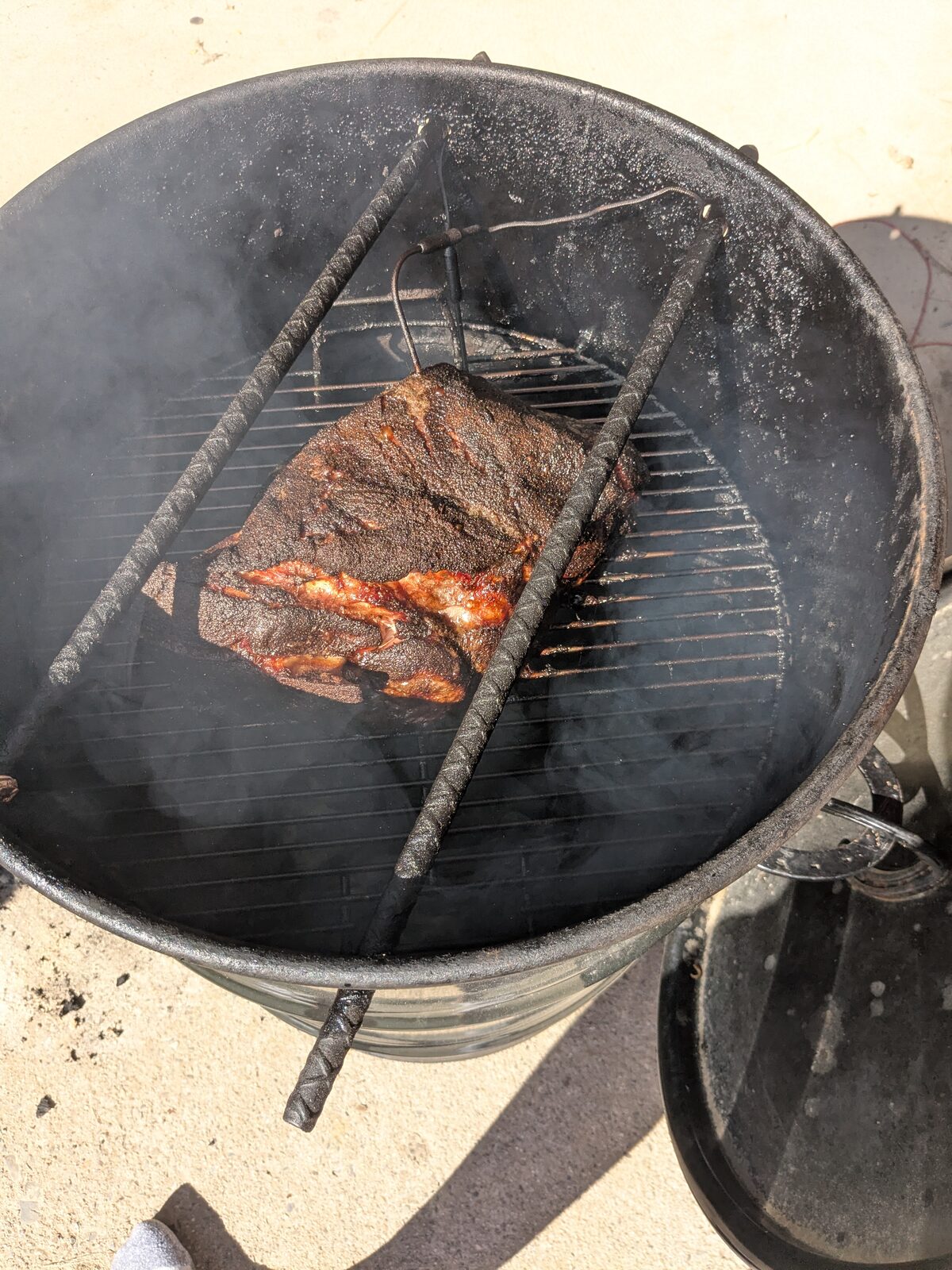
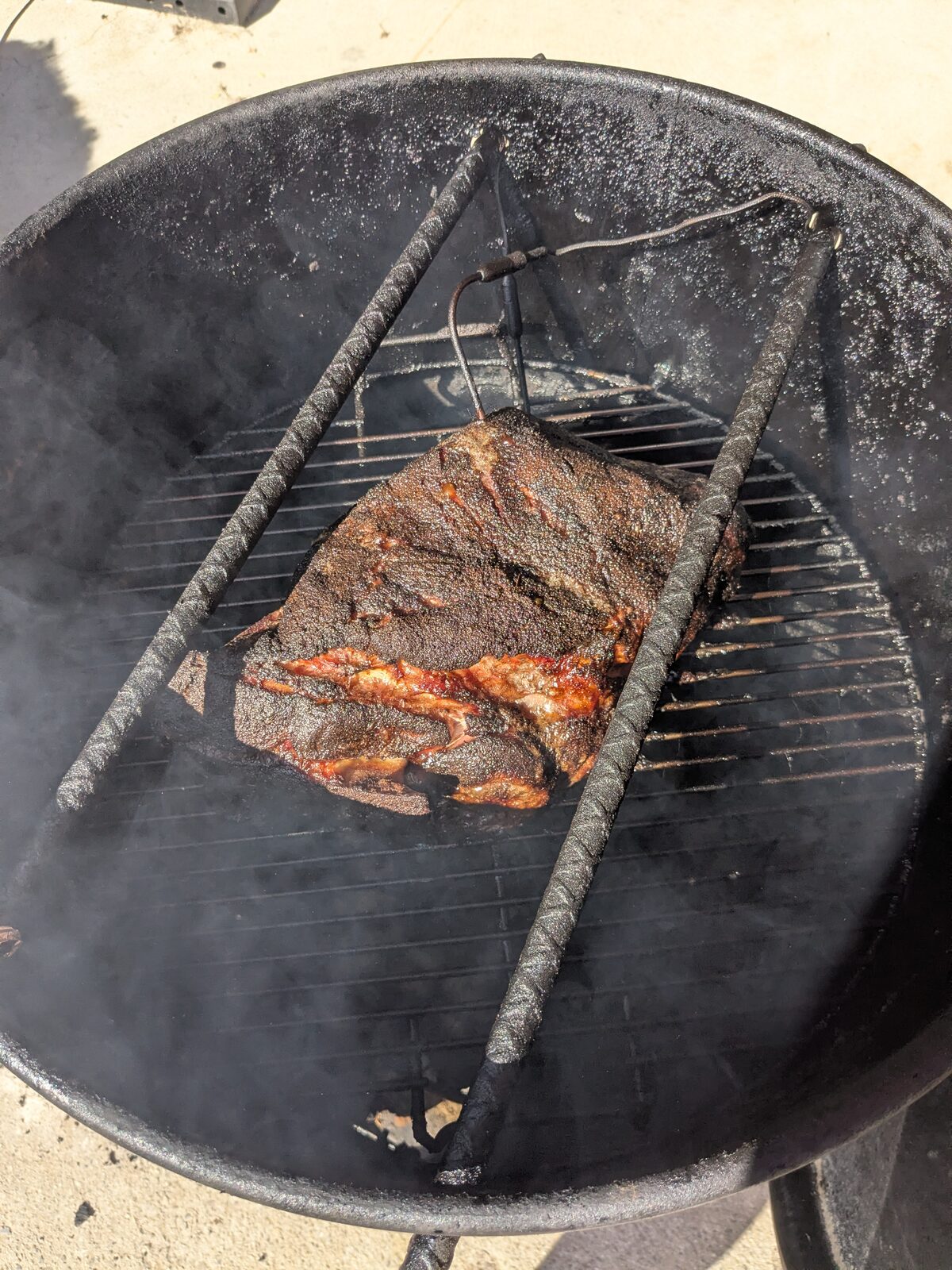
Seven hours of uncovered smoke, and the difference from the wrapped method is not subtle. Where the usual cook produces a dark, slightly yielding bark, this is a dry, pronounced, faintly armoured shell — matte black-brown across the top, with the rendered seams glossy where fat found its way out. Between them, these two frames are the whole experiment.
-
7
Wrapped with what was in the house
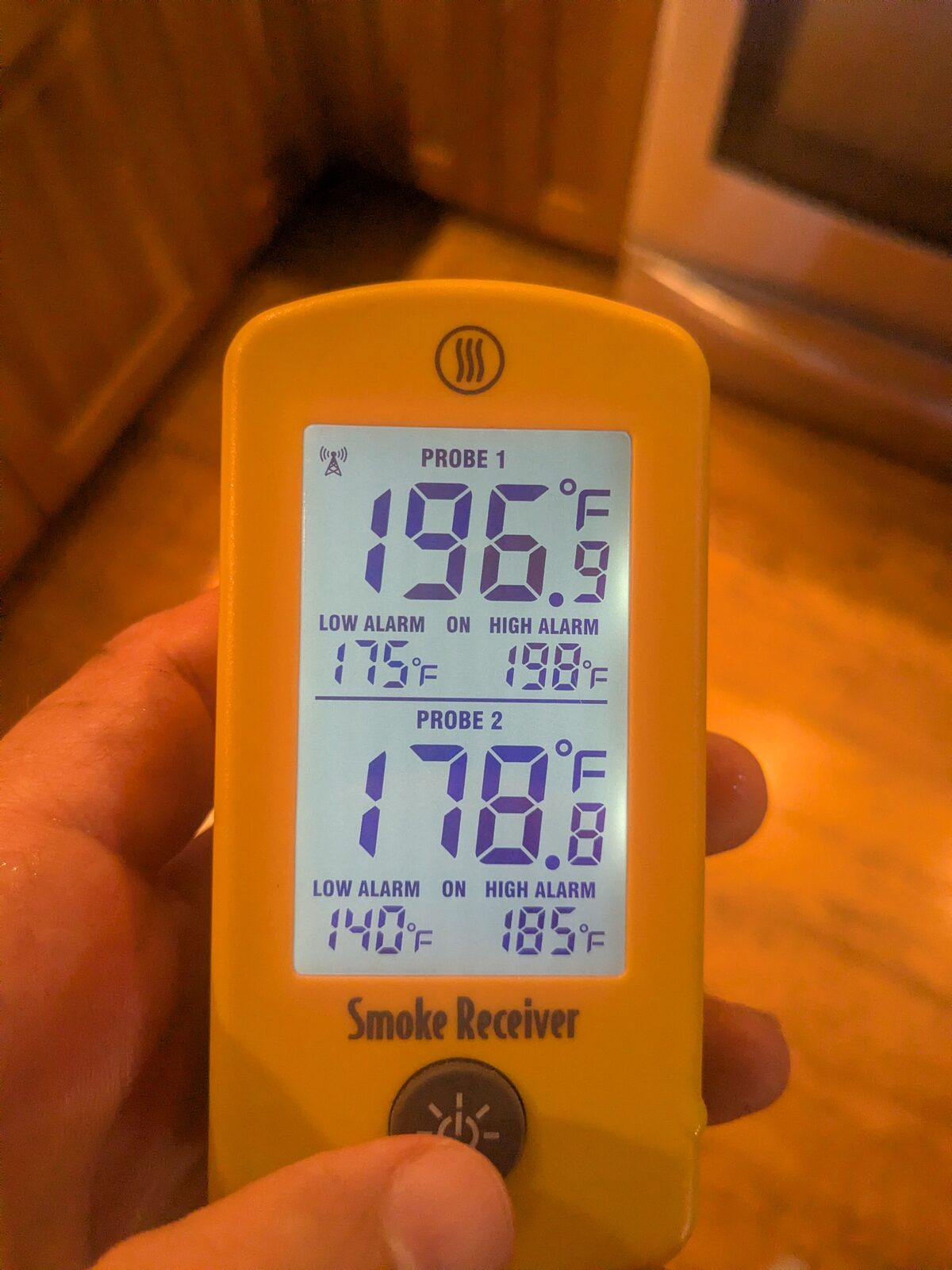
No apple cider vinegar in the cupboard. The wrapping liquid was therefore a tablespoon of lemonade and a tablespoon of white wine — a tiny amount of water, acid and sugar, nowhere near enough to turn the paper into a braise. Meat 196.9°F, oven environment 178.8°F. The hold has begun, and the numbers show exactly what it’s for: the shoulder is now cooling slowly through the range where collagen keeps converting instead of climbing toward 205°F.
-
8
Steady state
Meat 172.7°F, oven 177.4°F. From 200°F down to 181°F in the first hour, then 174.7°F, then this — the curve flattening out as meat and oven converge. My oven’s floor is 170°F and it actually cycles in the high 170s and low 180s, which is a more active hold than a purist would choose. For a shoulder with a little resistance left at the bone, that turned out to be fine.
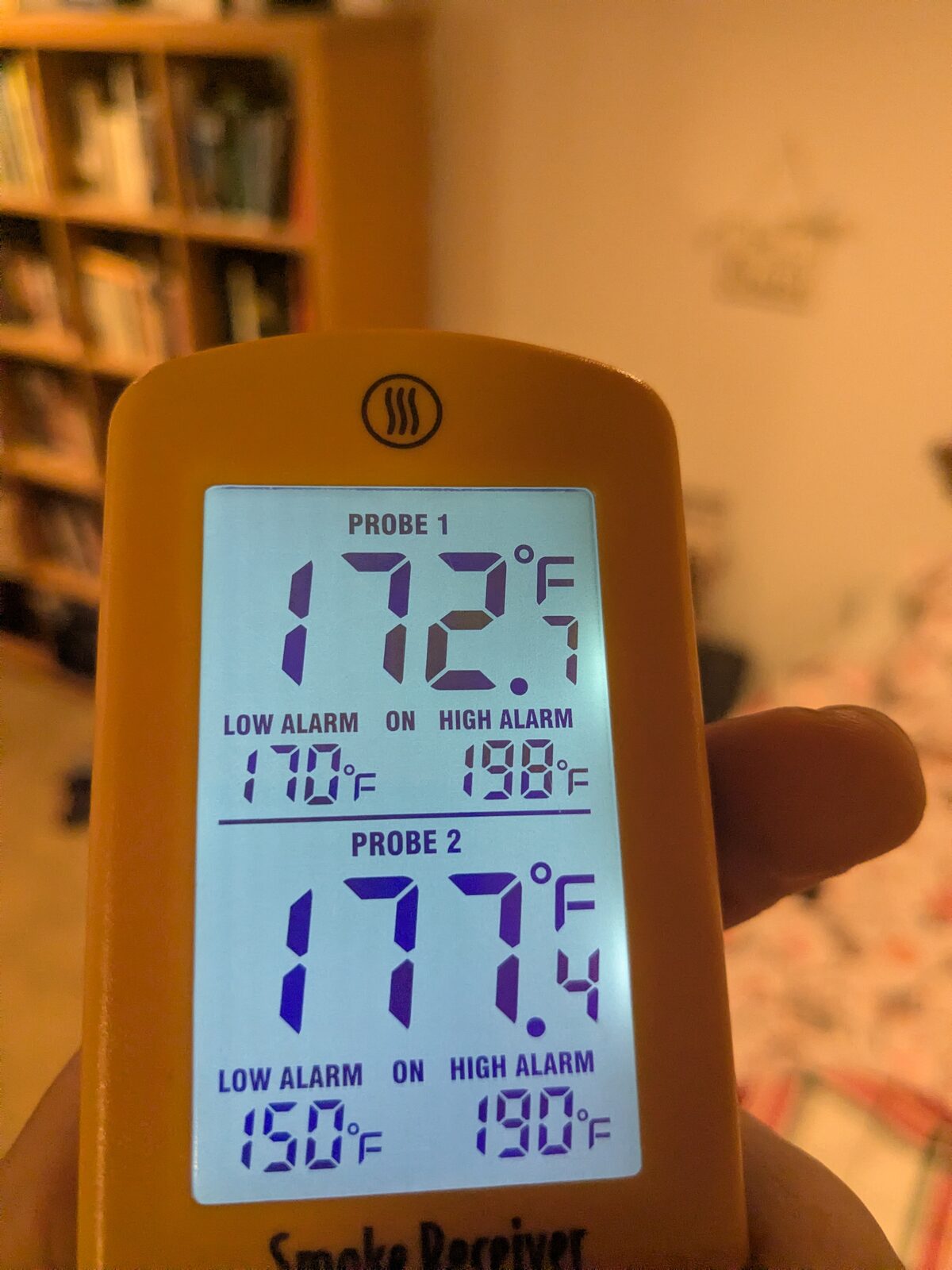
The probe log, at a glance
| Time | Meat | Pit / Oven | Note |
|---|---|---|---|
| 7:08 a.m. | 34° | 192° | Onto the grate, very cold |
| 8:14 a.m. | 58° | 288° | Fire fully established |
| 9:29 a.m. | 107° | 288° | One top vent blocked |
| 10:16 a.m. | 132° | 297° | Hottest reading of the day |
| 12:13 p.m. | 176° | 290° | Slowdown, but no real stall |
| 1:14 p.m. | 189° | 288° | Recovered from a mid-270s dip |
| 2:15 p.m. | 200° | 284° | Probed loose except near the bone |
| 2:36 p.m. | 197° | 179° | Wrapped; hold begins |
| 3:36 p.m. | 181° | ≈180° | One hour in; falling fast |
| 4:28 p.m. | 175° | 183° | Curve flattening |
| 5:10 p.m. | 173° | 177° | Steady state; left alone until service |
Section three
The Verdict
Good pork. Interesting pork. Emphatically bark-forward pork. Not my favorite — and knowing that is worth more than the cook itself.
Bark: the question is answered, maybe too well
Four uncovered hours above 160°F produce something categorically different from the wrapped method — a real crust rather than a firm skin. Mixed through the pulled meat it reads as assertive and a little relentless. It is genuinely more bark. It turns out I did not want the maximum.
Moisture: no penalty I could detect
The thing I was most worried about did not happen. Seven hours uncovered on a 290°F fire followed by a wrapped hold produced an interior indistinguishable from the usual method once pulled and mixed. Whatever the unwrapped run costs, it does not appear to cost juiciness.
The stall is not what I was told
At a steady 285–295°F, an unwrapped shoulder slowed in the 150s and 160s and then kept climbing. Seven hours from 34°F to 200°F is faster than the wrapped-at-165 cook usually manages. Part of that is the hot fire, and part is that a dry-brined surface stops evaporating quite as freely as the folklore assumes.
The oven is a tool, not a crutch
This cook did not prove that the oven finish is unnecessary. It proved that the oven finish is one of two finishing strategies with different strengths. When the food must be on the table at five o’clock, the oven is how you promise that. When there is a whole open day and the point is bark, the barrel can carry it the whole way. Having both is better than having a favorite.
Probe tenderness beat the thermometer
Pulling at 200°F because the probe said loose — rather than waiting for a number — and then letting a two-and-a-half-hour hold finish the tight spots near the bone worked exactly as hoped. This has since become the finishing rule for everything on this site.
Where it leads
If wrapping at 165°F is too early for the bark I want and never wrapping is too late, the answer is somewhere in between — ride it uncovered to around 180°F, then wrap and hand it to the oven. That is the method described on the working ideal, and it exists because of this cook.